Your clients already give you the best creative angles
The best words to sell are often already in customer calls, tickets and messages.
Share on LinkedIn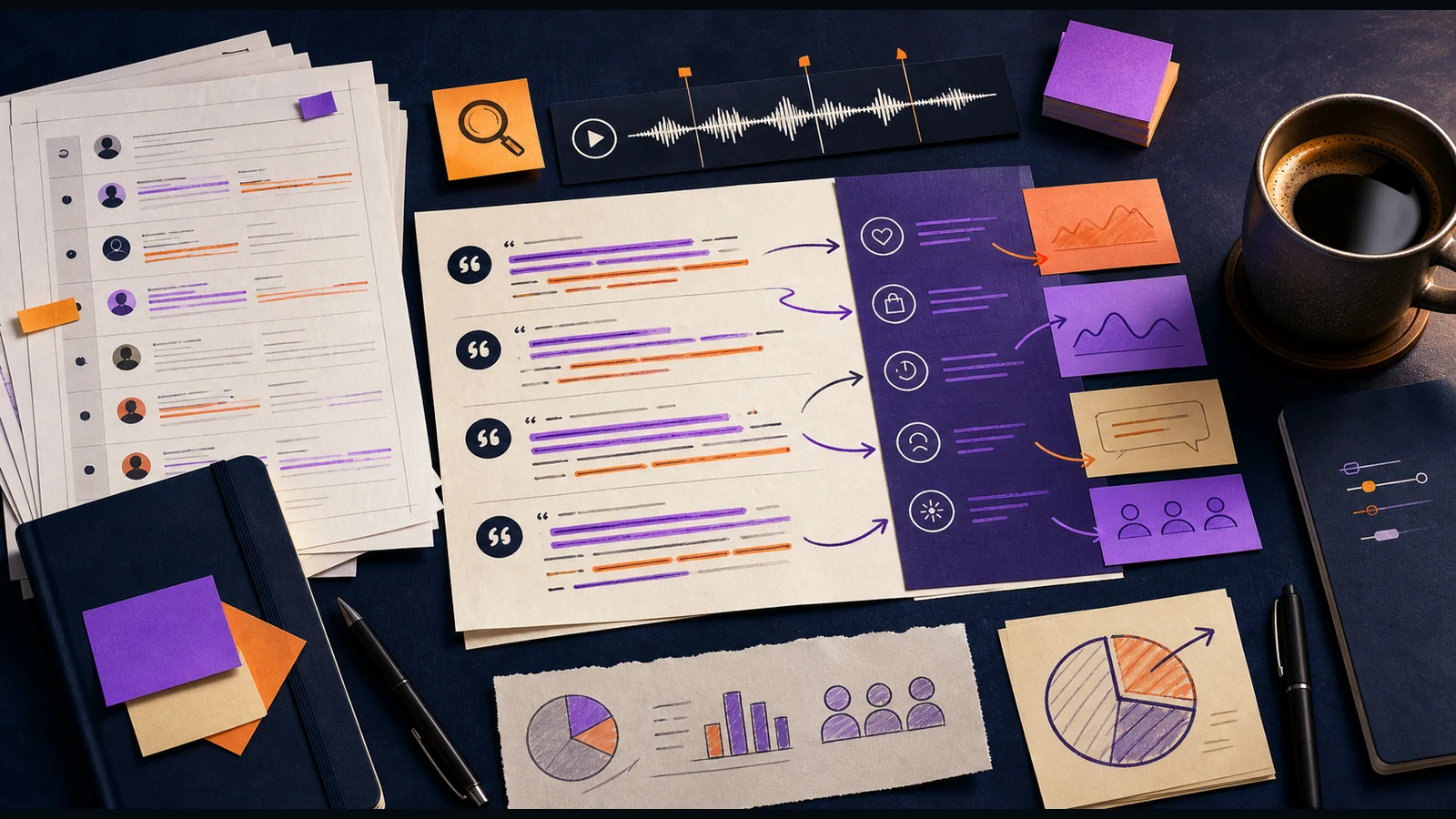
Customer research is not about collecting compliments. She looks for the moment when a person started looking, the alternative they considered and the fear that delayed their decision. These details can then guide the offer, creative, and page.
Question the timing of the decision
Asking why someone bought often produces a polite answer, reconstructed after the fact. Useful questions go back to the front: what was happening, what solution was being considered, and what concern delayed the decision?
Concrete details are more valuable than adjectives. Rarely will a person say that they wanted a seamless experience. Instead, she will explain what made her give up or come back.
Example of a useful question: What did you try just before contacting us, and what didn't work? An answer like I didn't know which option to choose can give an angle on the comparison and evidence to add to the page.
Ordinary sources are often the best
Sales calls, support, reviews, internal search and cart abandonments form a useful corpus. The job is to spot the recurring patterns, not to choose the most spectacular phrase.
Classify the verbatims by trigger, fear, expected result, alternative and requested proof. The classification creates a direct link with the creative brief and the landing page.
On a corpus of 50 conversations, count the number of times each tension appears and note the source. A pattern present in 3 trades does not carry the same weight as a pattern present in 22, but neither automatically becomes a market truth. Then you have to test it.
An angle must return in front of customers
An angle from a few conversations is a lead, not a market truth. Test it in a creative, page, or sales conversation, then see if it attracts the right problem.
The loop is simple: listen, formulate, test, listen again. It requires less staging than a large annual workshop and provides a more useful memory for marketing.
To close the loop, associate each angle with a hypothesis and a metric. If the angle attracts clicks but not qualified requests, the problem may be with the promise, the proof or the page. Customer feedback is then used to choose the next verification.
The voice of the customer is not a page decoration. It is a source of decision.
What to do with this
- Look for scenes and decisions, not compliments.
- Group the verbatims by tension and expected proof.
- Test each angle then return to check on the ground.
Circulate the research in the briefs and go back and check the angles on the ground. An isolated sentence perhaps inspires an idea. A repeated pattern helps in making a decision.