LTV won't save a mediocre acquisition
A theoretical customer lifetime value should not excuse an acquisition that destroys margins today.
Share on LinkedIn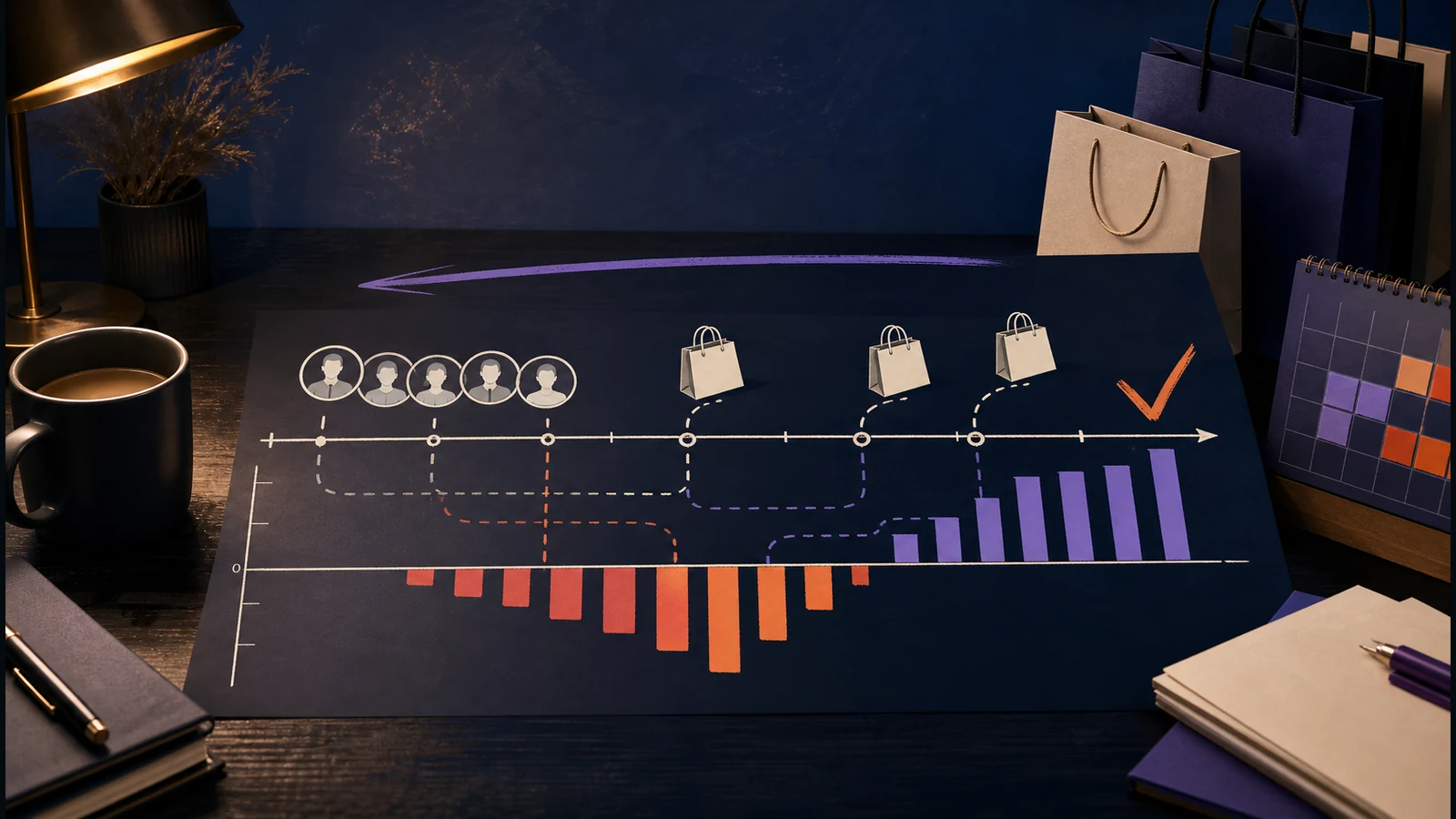
LTV helps to think about repurchase, but it becomes misleading when a broad average replaces the observation of cohorts. A future order does not have the same certainty as a margin already collected. Both can fit into a pattern, as long as they remain separate.
An average erases useful differences
Average LTV often mixes channels, products, and customer tenure. It can hide one cohort that repurchases and another that never returns.
A value observed over a short period does not have the same status as a value projected over several months. Both can be used, but the team must know which is a fact and which is an assumption.
Example: a cohort of 100 new customers produces CA$8,000 in cumulative margin after 30 days. We can measure this amount. We cannot yet present it as the 12-month value without a repurchase history or documented hypothesis.
Cash flow does not wait for the model
An acquisition can become profitable over a long period while weakening cash flow in the short term. The acquisition cost, the repurchase period and the margin collected must be read together.
Do not value a future order as income already observed. Age the cohorts and see if the repurchase promise holds up over time.
If the acquisition cost is CA$42, the initial margin observed is CA$28 and the second purchase remains hypothetical, the customer is not profitable on the first order. The model can test the break-even point, but it must show the starting deficit and the time it takes to recover it.
Three scenarios to avoid the comfort of the single number
Separates what is observed, what is expected, and what would be necessary to justify the current cost. This separation makes visible the point where the model stops describing the activity and begins to desire it.
If acquisition only works in the necessary scenario, it is still not robust. Work on the offer, retention or conversion cost before increasing media pressure.
Presents at least three views: margin collected within 30 days, margin observed over the available horizon and projected margin with a repurchase hypothesis. This breakdown allows you to see if the problem comes from price, basket, retention or media cost.
LTV is a working hypothesis, not a license to spend.
What to do with this
- Break down LTV by cohort, product and useful channel.
- Separate observed income from projected value.
- Test profitability with conservative scenarios.
Works with cohorts, a defined horizon and a margin per client. If profitability depends entirely on a future you haven't yet observed, slow down the spending and test the hypothesis.