Advertising creation: test less, learn better
Twenty almost identical variations do not form a test plan. Above all, they can multiply files without reducing uncertainty.
Share on LinkedIn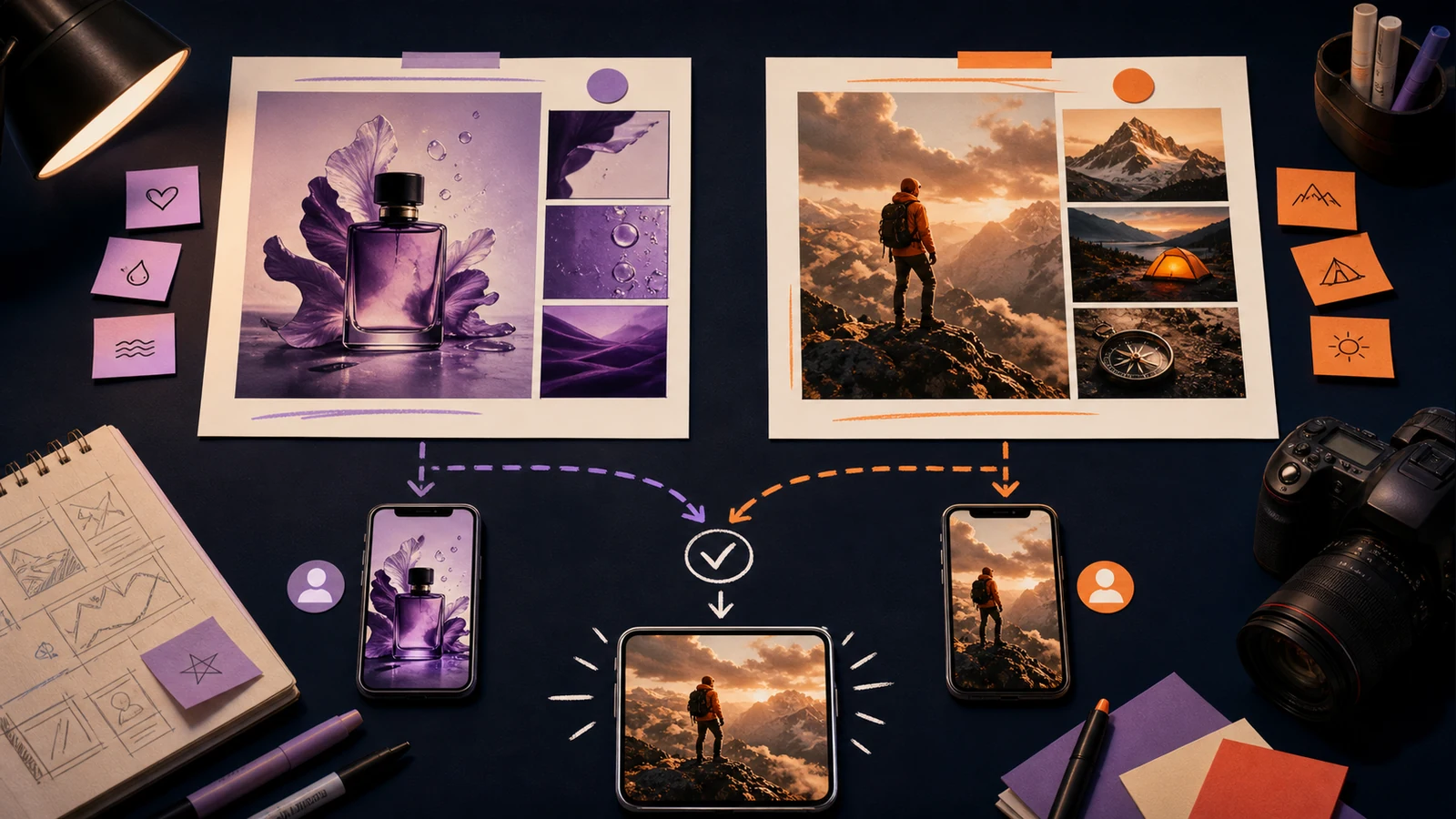
A useful creative test pits hypotheses against each other that the team can distinguish: the problem being put forward, the promise, the evidence or the format. If everything changes at once, the result can go up or down without explaining the next decision.
The brief must contain a question
An experiment begins with a question that the team can decide. Does the promise of saving time attract more than the product demonstration? Does the evidence reduce a specific objection?
The question protects the brief against the automatic production of a new version. It also says what data to look at when the test is finished.
Example: the hypothesis can be: a demonstration reduces doubt better than a general promise. The primary metric remains qualified conversion. CTR and cost per click are for understanding behavior, not declaring a winner too early.
Separate the variables that carry an idea
One cycle may compare two problems, then another two proofs. Changing the hook, the visual, the offer and the page at the same time makes victory difficult to reproduce.
The degree of separation depends on the volume of conversions. When the signal is limited, the differences must be strong enough to be readable. Clicks, adds to cart and qualified requests can then complete the reading, without replacing the final conversion.
Let's say one creative gets 1,000 impressions, 30 clicks, and 3 conversions, while another gets 1,000 impressions, 20 clicks, and 4 conversions. The first wins on CTR, the second on conversion. The decision depends on the objective and the quality of these four conversions, not on an isolated metric.
A test is only useful if it leaves a trace
At the end of the cycle, note what was compared, in what context and what you will do next. A winning creation gives a lead. It does not give a law valid everywhere.
Categorizes results by angle, audience, format and evidence. This memory avoids repeating the same tests and makes the next brief more precise.
Adds the context of the test: dates, budget, distribution, offer, landing page and optimized event. Without this information, a winning creation becomes an impossible-to-transfer story. With them, it becomes a reusable hypothesis in a new cycle.
A variation is only a test if it can change the next decision.
What to do with this
- Name the hypothesis before producing the variant.
- Test differences strong enough to be readable.
- Document the context before reusing a result.
Start with a question, produce a visible difference and note what the result allows for later. The objective is not to fill a file with creations. It's better to choose the next one.